AI is everywhere now, but most folks still see it as just ChatGPT or image generators. The truth is, AI covers much more ground. It runs in software, business processes, search engines, robotics, and more. In this post, here’s a plain view of the “AI Umbrella” — a way to see what’s really out there and how to use it to solve real problems, not just chase hype.
What Is the AI Umbrella?
AI is a big term. It wraps up everything from crunching numbers in Excel to self-driving cars and chatbots/AI Agents. This umbrella covers many areas, and each one is changing fast. Some ideas fade, some thrive, and others turn into new things. AI is not a magic trick — and it’s not new. For over sixty years, it’s helped businesses do work better, from simple data entry to complex automation.
Hype vs. Reality
Each cycle brings promises: “AI will change everything.” But those promises rarely deliver overnight. Just like Excel automated bookkeeping but didn’t end jobs, GenAI (like ChatGPT, Claude, Gemini) does not replace human work — it just shifts what we do. Jobs evolve. AI lets us do work faster, spot patterns, and solve tricky problems. But to really get value, businesses need a clear plan, not just headlines.
The AI Umbrella Framework
So how do you make AI work for real business needs? Use the “AI Umbrella” to map your problem and pick the right tool. Here’s a simple view:
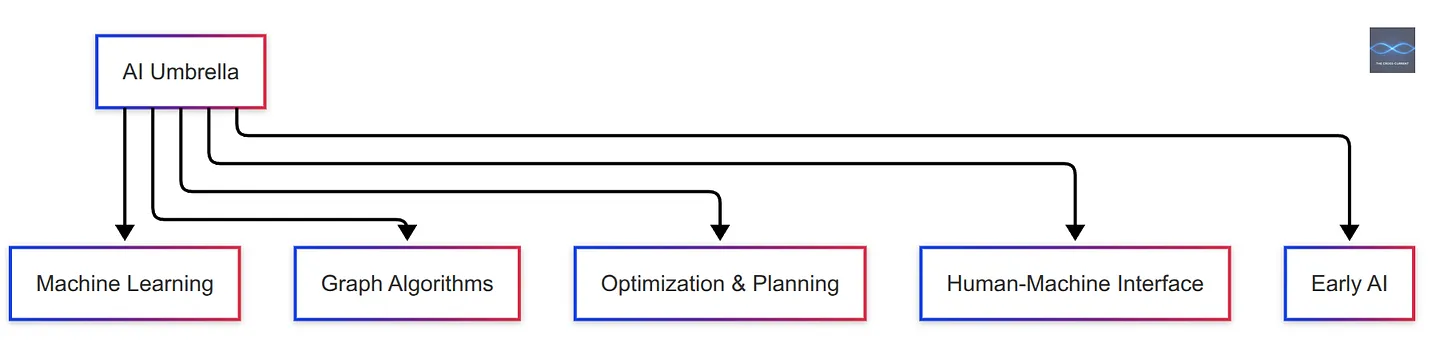
It covers everything from classic number crunching to the newest breakthroughs. Think of AI like a big toolbox, not just one gadget. Well we are going to take a deeper dive in each pillar, but a small disclaimer this is not-an-exhaustive list.
Machine Learning (ML)
Machine learning drives most real business value in AI today. It focuses on finding patterns in data to predict outcomes, classify information, or spot trends that humans might miss. Unlike the flashy GenAI tools, ML quietly runs recommendation engines, fraud detection systems, and supply chain optimization across industries. here is a non-exhaustive view of Machine Learning (ML)
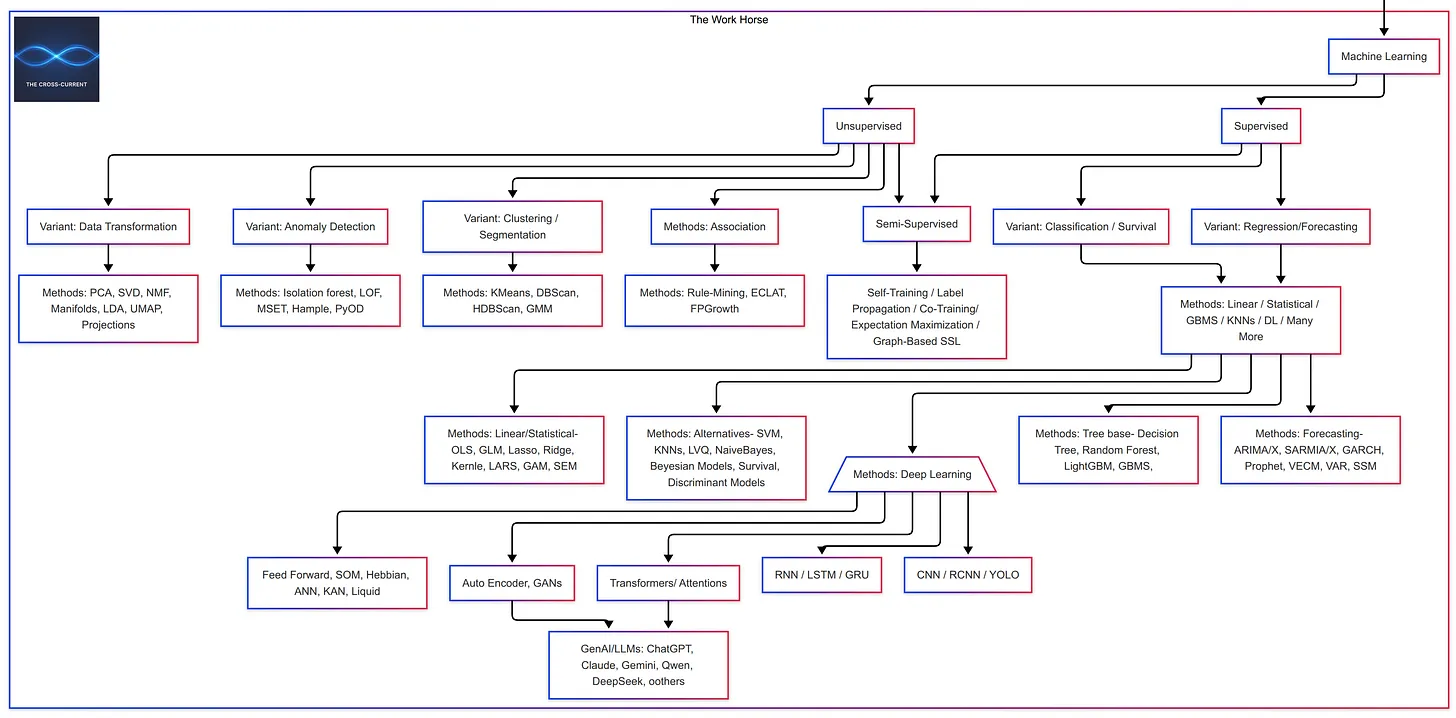
Notice , at the bottom is you GenAI, and above is the dearth amount of research that has went in that is a a way bigger chunk of AI. Here are some nuggets for you thoughts:
Supervised learning delivers 25-30% ROI on average, with applications like fraud detection showing 150% ROI within 9 months. Marketing automation using ML achieves up to 544% ROI annually. This is all about finding answers with labeled data.
Unsupervised methods excel at finding hidden patterns - clustering helps retail companies segment customers for personalized campaigns, while anomaly detection catches equipment failures before they happen. And this is all about spotting patterns in unlabeled data.
ROI Examples:
Predictive maintenance: 400% ROI in 6 months by preventing costly equipment breakdowns
Customer segmentation: E-commerce businesses see 27% increase in purchase likelihood through ML-powered personalization
Graph Algorithms
Graph algorithms map connections between data points, revealing relationships that traditional databases can’t capture. Think of how Google’s PageRank revolutionized search by understanding link relationships, or how LinkedIn suggests connections by analyzing your professional network.
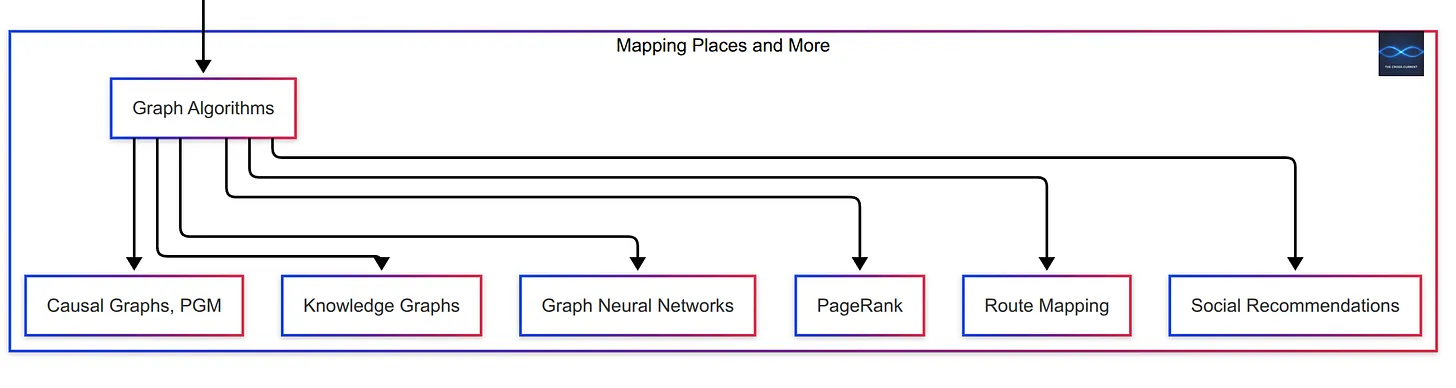
Graph algorithms are used in variety of ways:
Neo4j customers report 417% ROI over three years, with 20% improvement in business results and 60% faster time-to-value. Graph databases excel at real-time pattern recognition and complex relationship analysis.
Financial services use graph algorithms for fraud detection by mapping transaction networks - one e-commerce company reduced fraud risk through real-time pattern detection of suspicious shipping routes.
Maps: Google Maps uses Dijkstra’s and A* algorithms to find optimal routes through road networks, processing millions of nodes with real-time traffic data and ML predictions for dynamic rerouting.
Telecom: BGP uses Bellman-Ford for inter-domain routing between networks, while OSPF runs Dijkstra’s algorithm within networks for shortest-path calculations and load balancing.
ROI Examples:
Fraud detection: Financial institutions prevent losses through network analysis, with ROI justified by avoided fraud costs
Recommendation systems: Social platforms and e-commerce sites drive higher engagement through connection-based suggestions
Optimization & Planning
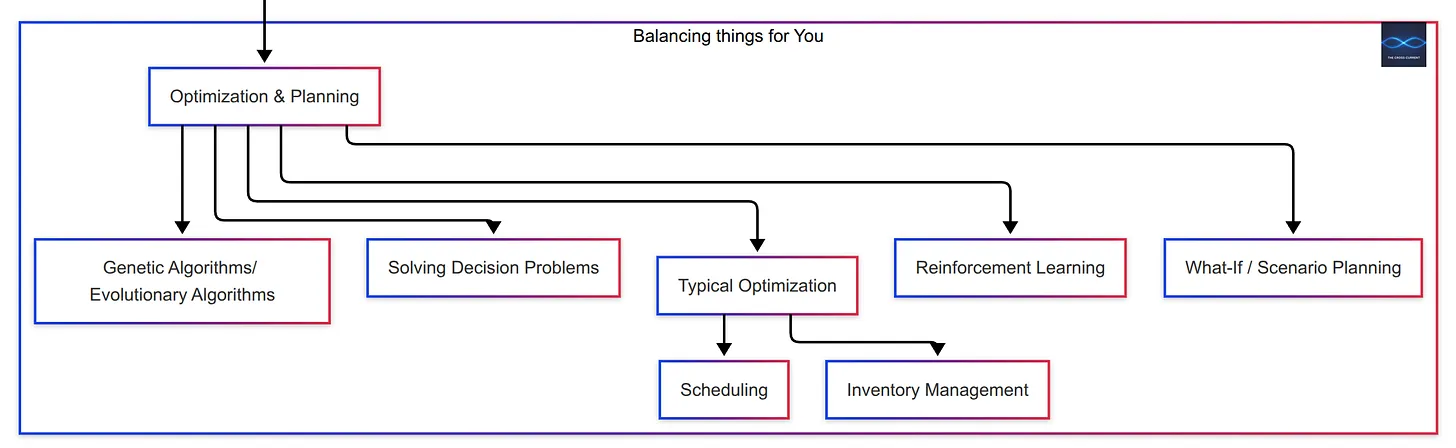
Optimization tackles the “best way” problems - finding the most efficient routes, optimal inventory levels, or ideal resource allocation. This field delivers some of the highest ROI because it directly cuts waste and improves efficiency in existing operations.
ROI Examples:
Route optimization shows 15-30% reduction in travel costs, with companies like cold drink bottlers cutting fuel costs by 12% while increasing shop coverage by 18%. CPG brands report 19% savings on field visit costs through AI-based routing.
Supply chain optimization delivers 80% ROI within 12 months by reducing inventory costs and improving delivery performance. Manufacturing scheduling optimization can achieve 172% ROI through better resource utilization.
Inventory management: 30% reduction in holding costs while improving on-time deliveries by 25%
Production scheduling: Manufacturers see 20-30% cost reduction through optimized workflows
Human-Machine Interface
This pillar focuses on how humans and machines work together - from industrial robotics to neural interfaces to your mobiles to whats is possible future. It’s about extending human capabilities rather than replacing them, creating hybrid systems that combine human judgment with machine precision.
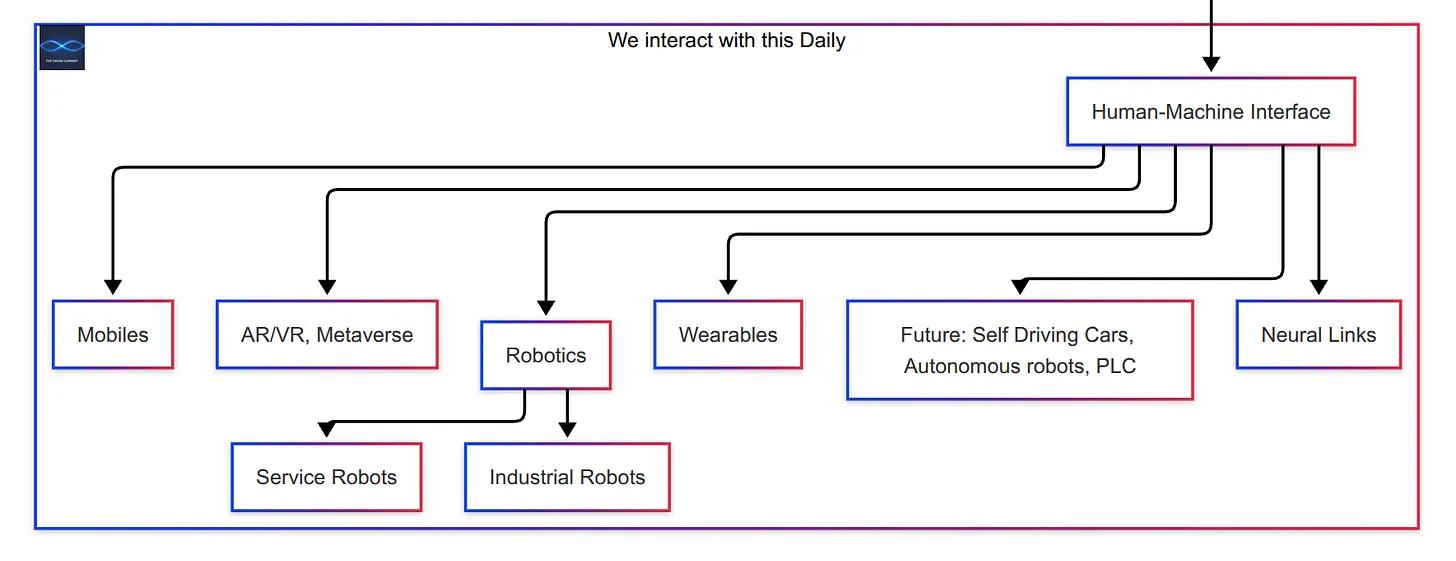
ROI Examples:
Industrial robotics typically delivers ROI within 3-5 years, with autonomous mobile robots showing quick implementation and measurable labor savings. BMW reported 25% reduction in production time and 30% cut in operational costs within two years.
Warehouse automation ranges from $5-15 million for semi-automated systems, with companies seeing 24/7 operation capabilities and reduced human error rates.
Factory automation: 20% average productivity increase with significant operational cost reductions
Customer service automation: 30% reduction in support costs with faster query resolution
Faded but Foundational AI
Early AI systems like expert systems and rule-based engines laid the foundation for today’s AI. While many faded due to rigidity and high maintenance costs, their core principles live on in modern decision support systems and automated workflows.
Some thoughts:
Expert systems peaked in the 1980s but declined due to scalability issues and inability to handle ambiguity. However, their legacy continues in clinical decision support systems and business automation tools.
Clinical decision support: Healthcare systems still use rule-based approaches combined with ML for diagnosis assistance
Business automation: Modern workflow systems trace back to expert system principles, delivering consistent decision-making in structured environments
Older methods like rule-based systems, expert systems, and fuzzy logic now live inside more advanced techniques like tree-based ML and probabilistic models. Legacy system integration of modern AI shows that 95% of GenAI pilots fail to show real ROI, often because they ignore lessons learned from early AI implementations.
The Market Numbers
Here’s what the data says about the real business side of AI:
- The whole AI market is about $235 billion.
- GenAI (think ChatGPT) is just 8.6% ($20.2 billion). The rest — traditional ML — is 91.4% ($194.6 billion).
- Traditional AI gets better results: up to 30% ROI, while GenAI averages 12%.
- Predictive maintenance delivers up to 400% ROI in six months. Fraud detection? 150% in under a year. LLMs do much less: about 12% over the same time.
What Makes AI Projects Work?
- Using external tools yields a 67% success rate.
- Internal builds succeed only 33% of the time.
- Many spend most budget on sales and marketing for AI, but real savings come from automating back-office work.
- Traditional machine learning projects finish in 3-6 months. GenAI takes 3-12 months and needs more tuning.
Putting It All Together
Before starting any AI project, ask: What problem am I trying to solve? Use the AI Umbrella map to find what fits. Is it prediction, classification, pattern finding, or optimization? Do you need machine learning, deep learning, or just smarter software? This clarity saves money, time, and helps get actual results.

Next time someone pitches an AI solution, ask “Which part of the AI umbrella are we using?” And “How does it solve our actual problem?”, or You can learn to ask specific question for your use case,, but ask for clarity and not hype. Use the framework above as your map. AI isn’t a buzzword — it’s a toolbox. The right tool solves the right problem. And that’s how you make AI work for your business, today and tomorrow.
This is just the start. I’m building an Enterprise AI series that shows how to combine these AI pillars for real business impact.
Next may be: How one manufacturing company used ML, optimization, and robotics together to cut costs by 40%. Subscribe to see the full breakdown or book a strategic call