
Every value chain has a specific point where money, time, or quality leaks out undetected. Most companies throw AI at symptoms. Find the leak first. Then decide if AI is the fix.
The Logic Leak is a situation when? - When your AI initiative isn’t failing because of a bad model. It’s failing because your data is answering the wrong question. And to fix this you need to find this leak, before you make and failed spend.
Simply speaking a Logic Leak is the point in your operational process where your data tells a story that doesn’t match what actually happened because the data was collected for a different purpose.
It’s not a data quality problem. It’s not a model performance problem. It’s a problem framing problem.
Once I was helping a F500 retail client with a demand forecasting problem.
Four failed attempts. Four different vendors. Each one came in, trained a model, showed 85–90% accuracy, and left. The models worked technically. The business results were zero.
The fifth approach wasn’t a better model. It was a better question.
We fortunately found the Logic Leak.
What Is a Logic Leak?
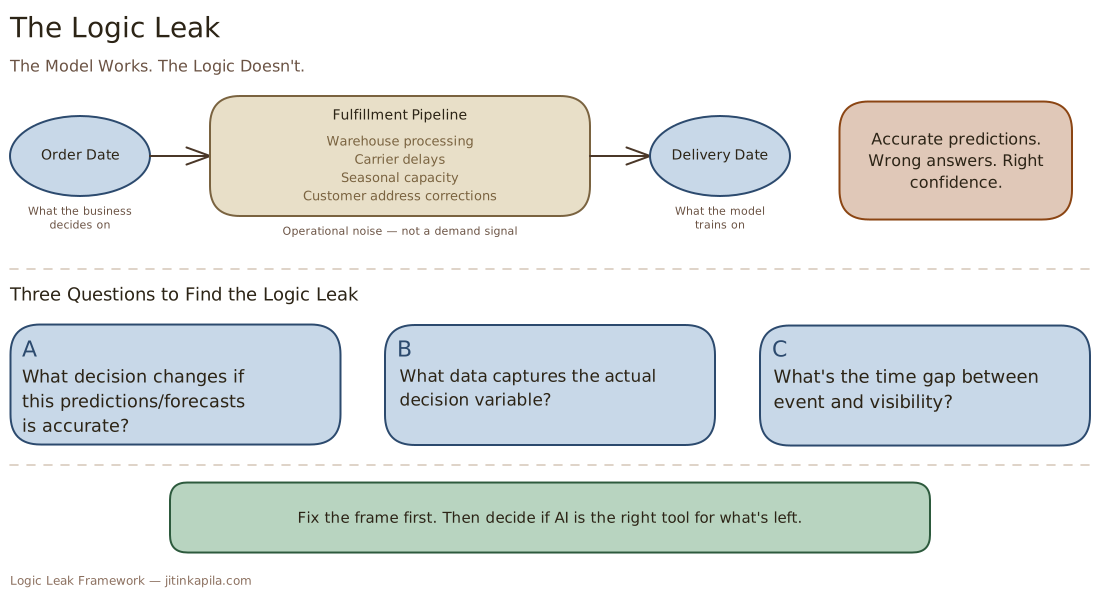
In this case: the retail team was forecasting on Delivery Date. Every prediction was calibrated against when customers received their orders.
But the business decision was made on Order Date.
Between Order Date and Delivery Date sits a pipeline of fulfillment variables :— warehouse processing time, carrier delays, seasonal capacity, customer address corrections. None of these are demand signals. They’re operational noise.
When you forecast on Delivery Date, you’re training your model to predict your own fulfillment capacity. Not customer demand. The model learns the wrong thing with great precision.
That’s the leak. The model works. The logic doesn’t.
How It Shows Up
The Logic Leak hides in three common places.
| Pattern | What It Looks Like | The Hidden Cost |
|---|---|---|
| Reporting Lag | Your weekly sales report shows Monday’s numbers on Friday | Every decision is fighting yesterday’s battle |
| Metric Mismatch | You’re optimizing for click-through rate. Your CFO cares about revenue | You’re moving the wrong lever |
| Wrong Time Horizon | You measure campaign performance in 30-day windows. Your product cycle is 18 months | The model sees success. The business sees a slow bleed |
Why AI Can’t Fix It
Here’s what most companies do. Model performance is poor. They buy a better model. Model performance improves. Business results still don’t move. They blame the data.
The data wasn’t the problem. The data was answering the wrong question.
You can have the world’s most accurate model trained on the wrong data, and it will produce wrong answers with great confidence.
AI doesn’t fix Logic Leaks. Finding the Logic Leak fixes the AI strategy.
Three Questions to Ask
Before you touch any AI tool, ask these three:
1. What decision changes if these predictions/forecasts are accurate? Not the model’s accuracy, the decision. What do you do Tuesday morning if the forecast is right versus wrong?
2. What data captures the actual
decisionvariable? Not the data you have. The data that answers the question you’re actually asking.3. What’s the time gap between when the event happens and when you see it? Every day of reporting lag is a day of decisions made on stale information.
The answer to question 3 exposes the leak usually.
(These three questions are the core of the AI Profit OS diagnostic framework. See how it works →)
The Pattern
After 15 years and ~$90M+ in AI portfolios, I can tell you the most common failure pattern:
.. Someone in the business, noticed a problem
-> They went to IT or a vendor
-> The vendor built a model
-> The model was accurate
-> The results didn’t come.
-> Someone in the business, noticed that problem
.. And cycle repeats!
Nobody ever went back to question 1. And nobody usually asks: What would have to be true for this to actually move the business?
That question helps you to find the Logic Leak. Everything else is just optimization theatre.
Before your next AI initiative — before the vendor, before the budget, before the pilot — find the Logic Leak, fix the logic, then decide if AI is the right tool for what’s left.
Most companies skip steps 1 and 2. They spend $500K on step 3. Then they wonder why the ROI never appears.
The Logic Leak isn’t a technical problem. It’s a framing problem — and based on 15 years of AI portfolio work across $80M+ in implementations, it’s always cheaper to fix the frame than to upgrade the model.
Your Next Step
If you want to find the Logic Leak in your own AI initiative, book a 30-minute call → or start with the AI Strategy Audit →.