10%+ margin expansion by predicting shelf life
+10%first-year margin expansion
Helping a multi-billion-dollar food exporter reduce claim exposure by predicting fruit quality before allocation.
Executive Context
A multi-billion-dollar food exporter was facing a large and recurring claims problem.
The business sold perishable fruit through dealers. Once the product reached the dealer network, quality issues could turn into claims. Dealers could say the fruit was not up to the expected mark and claim money back from the exporter.
That claim exposure was not a small operational nuisance. It was worth roughly 10% of revenue.
Even a small reduction could expand profit meaningfully.
The exporter had already tried internal forecasting attempts, but the results were not strong enough to support day-to-day allocation decisions. The business did not just need another forecast. It needed a practical way to decide which batch should move first, which batch could wait, and which market should receive which fruit.
The Actual Problem
The stated problem was claims prediction.
The real business problem was shelf-life uncertainty.
Every batch was not equal. Fruit quality depended on the grower, region, farming conditions, packaging, cold-storage behavior, and temperature exposure. Two batches that looked similar in the system could behave differently in the market.
The business needed to answer three plain-English questions:
- How good is this batch likely to be?
- How long can it safely remain in storage or transit?
- Which batch should be sent first to reduce avoidable claims?
The quality prediction was the seed. Shelf-life forecasting and inventory allocation were the outcomes.
Diagnostic Approach
- Batch Reality: The decision had to happen at batch level, not only at aggregate volume level.
- Quality Drivers: Grower, location, farm practices, packaging, temperature, and storage conditions all influenced how long the fruit would last.
- Commercial Exposure: The model had to identify claim risk early enough for the business to change allocation.
- Planning Window: The output had to support near-term fulfilment decisions over the next 1-2 months.
Strategic Intervention
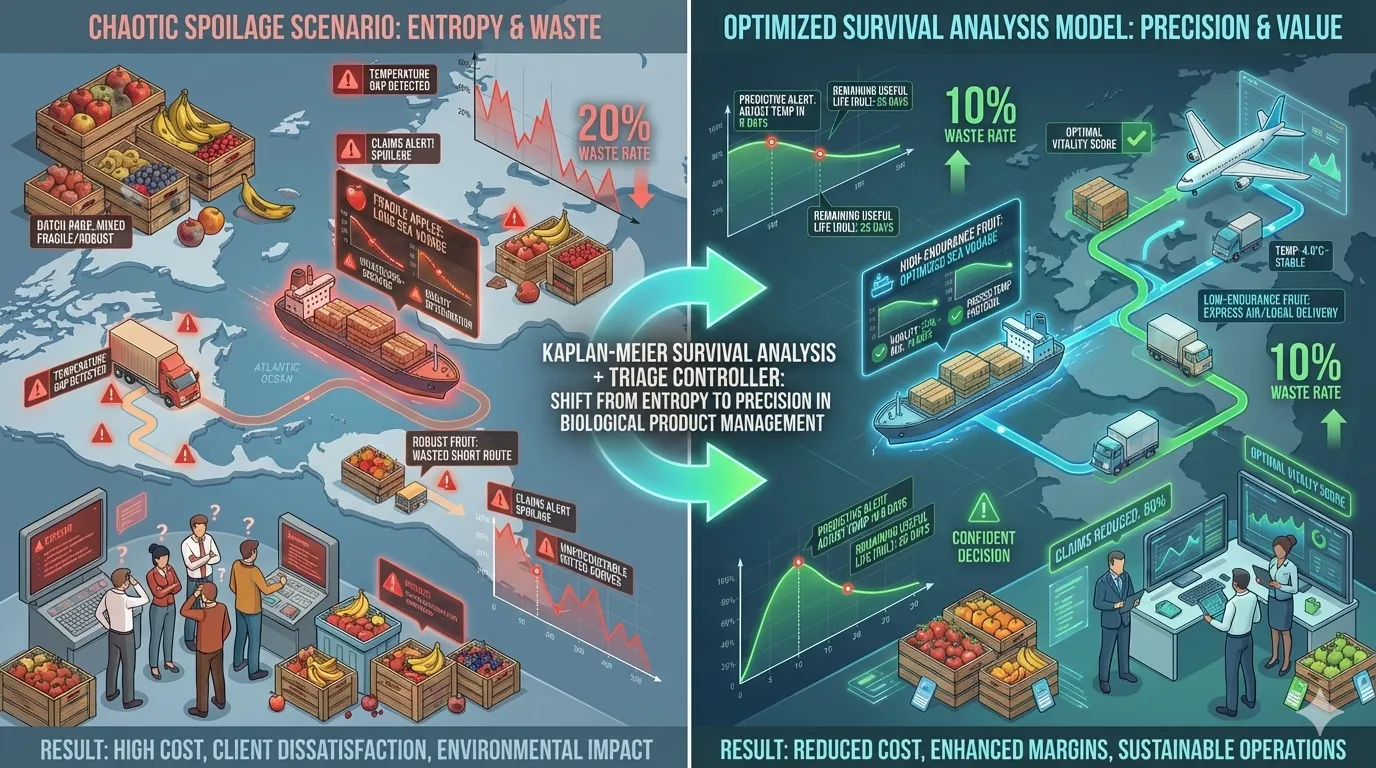
We built a shelf-life prediction system around batch quality.
1. Predict Batch Quality
The first layer estimated the quality risk of each batch using the conditions around how it was grown, handled, packed, and stored.
Instead of treating all available fruit as equal stock, the business could see which batches were more likely to create claim exposure if they waited too long or went to the wrong route.
2. Forecast Shelf Life
The second layer translated quality risk into a shelf-life view.
This helped the team understand how long a batch could remain viable under current storage and market conditions.
3. Optimize Allocation
The third layer supported allocation.
If a market needed volume in the next 1-2 months, the system helped rank which batches should be moved earlier and which could be held back. High-risk batches could be pushed faster. More stable batches could support longer routes or later demand.
The model did not need to predict the final claim amount directly, because claim amount depended on market price. The important business decision was earlier: identify which batches were more likely to create claims and move them before the value leaked.
Outcome
| Metric | Before | After | Impact |
|---|---|---|---|
| Claim exposure | Around 10% of revenue | More controllable | Earlier action on risky batches |
| Margin expansion | Baseline | 10%+ in year one | Better claim control and allocation |
| Quality risk view | Manual and reactive | Batch-specific ranking | The team could prioritize the highest-risk batches |
| Planning horizon | Broad volume planning | 1-2 month allocation support | Better fulfilment decisions |
| Model confidence | Internal attempts underperformed | ~89% validation confidence | Stronger basis for operational use |
Strategic Takeaway
For perishable goods, inventory is not just inventory.
It is inventory with a clock attached.
The business value came from predicting quality early enough to change the route, timing, and allocation decision. Once the team knew which batches were likely to degrade faster, they could move the right fruit first and protect margin before claims appeared.
The lesson is simple: if the product can expire, the supply chain should not only forecast demand. It should forecast shelf life.
Want to find the same kind of logic leak?
Start with a Clarity Call. We will look for the point where data, model choice, and operating decision stop matching.
Book a Clarity Call