The AI Confusion Tax: Why Companies Buy the Wrong AI
The AI Confusion Tax is the cost of choosing an AI tool before defining the business decision. See the vendor patterns, research signals, and scoping question that prevent it.
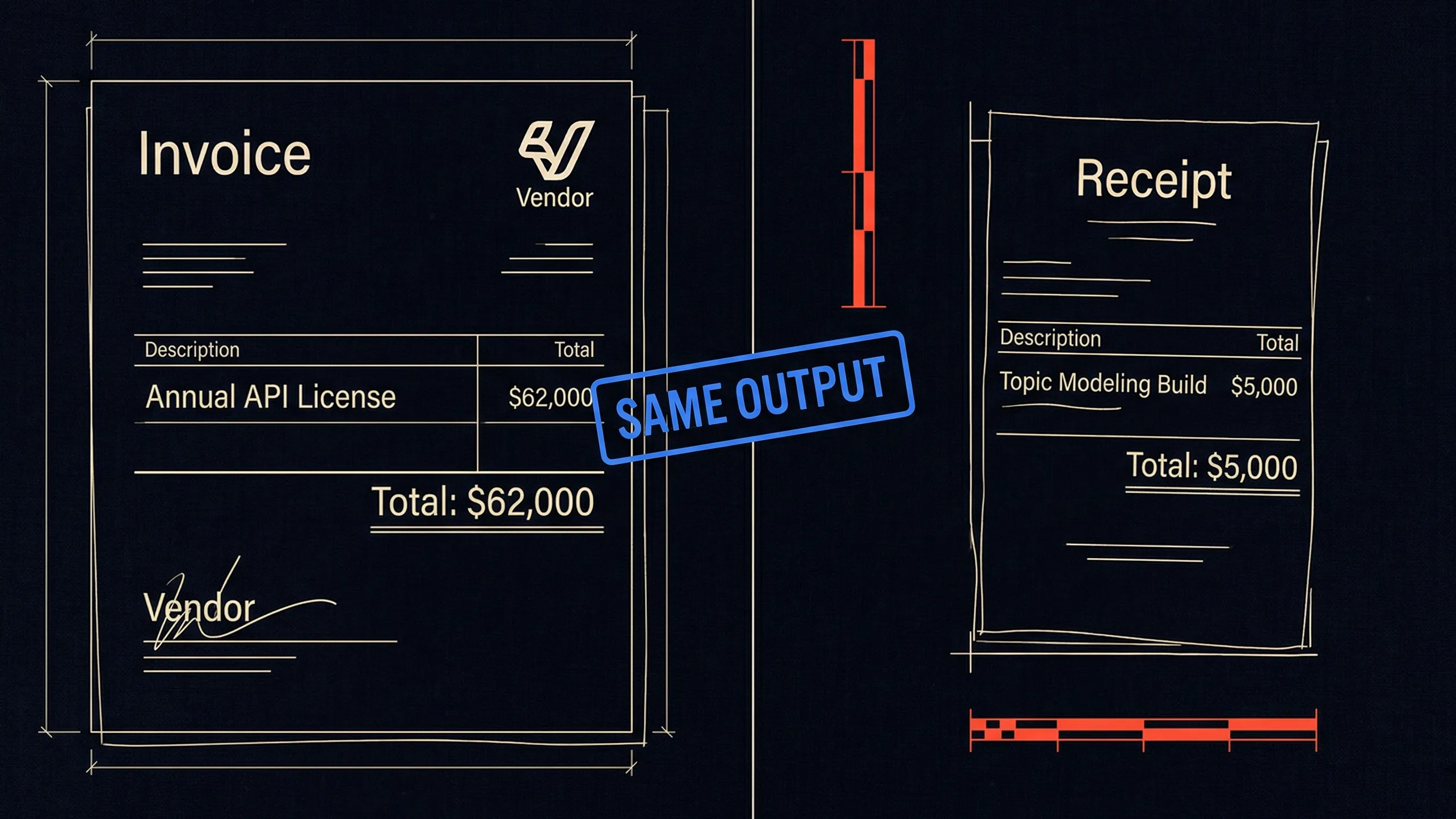
By 2026, a company can almost sign a $62,000-a-year GenAI contract for supplier categorization, when the boring answer is text categorization. That is the problem. Most companies know AI is more than chatbots. Their buying behavior still acts as if AI means one thing: GenAI, large language models, agents, and content generation. That is one tool in a 50-year-old toolkit. Classification problems have classifiers. Forecasting has regression. Anomaly detection has isolation forests. Time-to-event problems have survival models. Sometimes the boring model is the adult in the room, which is the whole point of the AI umbrella.
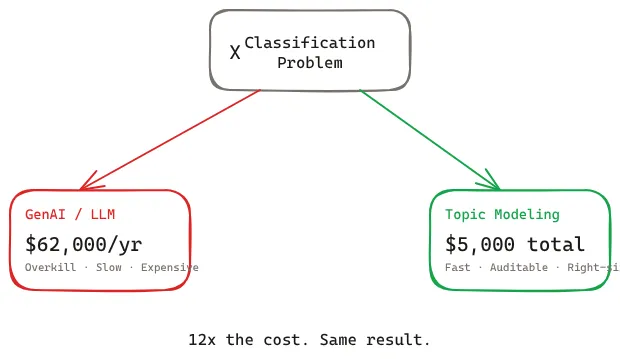
In one supplier-categorization quote I reviewed, the GenAI route was roughly 12x more expensive than a simpler classical NLP build before ongoing API spend. That gap is the AI Confusion Tax, and you pay it whenever a team chooses the AI label before it understands the business problem.
The case
A vendor quoted $62,000 a year for a supplier-categorization problem: $50K implementation, $1K a month in API costs. The same job with topic modeling would have been closer to $15K-$20K to build and about $10 a month to run. The company almost signed, because nobody told them another way existed. The same pattern shows up at industrial scale, like the automotive plant that replaced a deep-learning vision system with biomedical signal processing and cut inference from three minutes to under five seconds. The full story is here.
That quote is an example, not a market benchmark. But it is not an oddball. RAND Corporation says that, by some estimates, more than 80% of AI projects fail and lists misunderstood business problems, poor workflow fit, and technology-chasing as leading causes. Gartner predicted that at least 30% of GenAI projects would be abandoned after proof of concept by the end of 2025 because of poor data quality, inadequate risk controls, escalating costs, or unclear business value. McKinsey’s 2025 state of AI survey found that nearly two-thirds of respondents had not begun scaling AI across the enterprise, and only 39% reported EBIT impact. Different reports keep saying the same thing, including this 2026 AI-readiness synthesis: the model is rarely the only problem. The workflow is. The owner is. The metric is. The data system is. Even coverage of MIT NANDA’s GenAI Divide report comes back to integration, not model magic. That is one of the main reasons most AI projects fail.
What the confusion tax actually is
The AI Confusion Tax is the hidden cost of selecting an AI solution before defining the problem it has to solve. It shows up as overspend on the wrong tools, mismatched model types, and months of data preparation that never connect to a business decision. It is structural, not malicious. Vendors pitch what they sell, companies do not know the alternatives exist, and the tax lives in the gap between those two facts. Three patterns account for most of it.
1. Wrong AI type for the problem
A glass manufacturer wanted to organize their vendor base: which vendors sell which SKUs, how to consolidate for negotiating power. A vendor pitched a solution built on LLM APIs, which was expensive, slow, and hard to explain to a supply-chain manager. The actual problem was text categorization. Topic modeling, basic NLP, even keyword extraction would have solved it for a fraction of the cost. These are solved, auditable, cheap.
Text classification has its own version of this. In one 2024 paper, fine-tuned smaller language models consistently outperformed larger zero-shot prompted models across text classification tasks. The lesson is not “small model always beats large model.” The lesson is “task fit beats defaulting to the biggest model.” The vendor sold LLM because they sell LLM. The company nearly bought it because they did not know topic modeling existed. Same business output, very different cost curve. That is an information gap, and it is why GenAI is a plier, not the whole toolbox.
2. Wrong problem selected
This one costs the most over time. A food company wanted to predict when inventory would expire, so they built a classification model to answer “will this item decay or not.” It never produced useful outputs: low confidence, poor predictions, no usable time window.
The framing was wrong from the start. This is a survival analysis problem, not a classification one. You do not need to know whether an item will decay. You need to know when, and how much time you have to act. Classification gives a yes or no on the day you check. Survival analysis gives a time window, and in inventory that window is the difference between selling at full margin and writing off the batch, exactly the lever in this shelf-life case. The same mistake shows up in churn, where teams build “will this customer churn” classifiers and miss the gradual decline in engagement and spend that a survival model captures. The team blames the data when the data is fine. The root cause is almost always problem framing.
3. Data before decision
This one costs you in delay. Nearly every manufacturing and FMCG company I have worked with starts an AI project with a six-month data audit: cleaning, structuring, waiting for the right data, while the actual optimization opportunity keeps leaking. The question that comes too late is which decision we are trying to improve. Without that, you cannot know which data matters, and you prepare data that has nothing to do with the real problem. The order is decision first, data second, model third, which is the whole argument behind decision-first AI. Vendors do not push back. They scope the data work, and the delay is yours.
The pattern underneath
Vendors pitch what they sell, companies do not know the alternatives, and nobody defines the problem before selecting the solution. Every AI decision (vendor selection, project scoping, budget approval) can carry this tax. Sometimes it is $57K a year on the wrong tool. Sometimes it is months of data-prep delay. Sometimes it is a model that works technically and delivers nothing commercially. The invoice is the part above the table. Under the table sit integration, governance, security review, latency, workflow redesign, and the waste of solving the wrong problem.
Before you sign the next contract
Ask one thing before any AI project gets approved: does the person scoping this understand what they are scoping? Not whether the model is accurate or the vendor is credible. Can they tell you which AI type this problem needs (classification, regression, clustering, survival analysis) and explain why that type fits this specific business decision? If they cannot, they are guessing, and you are paying for the guess. That is also where the broader buying discipline matters, the six questions to ask before buying any AI tool, and the discipline to stop collecting tools you cannot integrate, which I cover in AI tool tourism.
If your AI projects keep hitting walls you cannot explain, the AI Strategy Audit finds the confusion tax in your current initiatives and tells you what to fix. I also write AI Cross-Current for operations leaders working through exactly this.
The Weekly AI Decision Brief

Strategy
AI in Automotive Quality Control: How ECG-Style Anomaly Detection found Faulty Engines in <5 Secs
A case of AI in automotive quality control where ECG-style anomaly detection caught 20 faulty engines hidden in 1.3M units, in under 5 seconds each, by defining normal instead of chasing rare faults.

Strategy
AI Strategic Skills: Where Should a CEO Draw the Line?
The essential AI skills for executives — from spotting vendor hype to owning the delivery of business value. How to move from Tier 1 to Tier 3 leadership.

Strategy
Why Most AI Strategies Fail
And how to fix it — the 3 silent killers of AI projects: Pressure, FOMO, and Anxiety. How to diagnose your project before you waste another dollar.