Who Should Explore AI Tools Inside a Business?
Give AI tool exploration to people who learn fast and understand systems, not by job title, and make every trial leave a record. A simple operating rule.

Short answer: give exploration to a system-aware learner or a low-risk newcomer, and consult the critical person who is slow to learn.
Not everyone in a business should be exploring every new AI tool. That sounds harsh, but it is practical. Exploration has a real cost: time, attention, setup effort, context switching, and the workflow memory it takes to evaluate anything properly. When everyone tries tools every week, the company gets distracted, and distraction wears the costume of innovation.
So the useful question is not who is interested in trying this. It is who can explore this without damaging the current system. This is the team-level version of AI tool tourism, and it has a cleaner answer than most companies expect.
Is Exploration a Temperament Problem or a Title Problem?
Most companies assign AI experimentation by title. IT should test it. Leadership should evaluate it. The workflow owner should try it. Sometimes that works. Often it does not, because the right explorer is defined by temperament.
Two traits matter. High learnability, so the person does not get stuck inside the tool. And a good sense of how systems work, so they are not impressed by features while missing the workflow impact. You need both. These are the same strategic skills that separate useful AI work from demo theatre, and they rarely line up neatly with an org chart.
Who Are the 2 People Who Should Explore?
The system-aware learner
The first good explorer already understands the business and can learn quickly. They know how work moves: where data comes from, where decisions happen, which handoffs are fragile, which processes are already overloaded.
When they test a tool, they are not asking whether it is cool. They are asking the same things worth asking before buying any AI tool: Does this fit our workflow? What does it replace, and what does it break? What new data surface does it create, and who maintains it? What happens when it gives a wrong answer? That person makes judicious use of exploration because they can tell capability from theatre.
The low-risk newcomer
The second good explorer is a newer person whose work is not yet deeply depended on. The point is the lower operational risk. While they learn the company, they can test workflows, compare tools, build small demos, and bring back a plain recommendation: use this, skip this, revisit later, or useful only for this narrow case.
You get exploration without disturbing core delivery, and the newcomer learns the business faster, because evaluating a tool forces them to understand how the work actually happens.
Who Should Be Consulted, Not Conscripted?
If I owned the team, I would be careful with one profile: the critical person who is slow to learn. They may be very valuable. They may own important work and keep the current system running. That is exactly why I would not throw them into every new experiment. Their time is expensive and their work is critical, so if they take too long to learn a tool, the company loses twice. Current work slows down, and the exploration still does not return enough value.
Consult them instead of conscripting them. Ask what the new system must preserve, where the current process breaks, and what would make adoption painful. Put them on the first run only when the tool directly affects their workflow and the business can afford the learning time.
How Do You Give Curiosity a Structure?
A company should not treat every AI launch as an internal emergency. Set a rhythm instead. A quarterly review is usually enough. If the business is moving fast, run a focused 2-week sprint with rules: start from current workflow hiccups, pick only a few tools, assign clear explorers, define what success means, and produce a go or no-go at the end.
Do not hand a full business sprint to random tool exploration. Keep it structured, time-boxed, and tied to a current problem. The north star is one question: what hiccup are we facing right now, and does this tool solve it without creating a bigger one?
How Does Exploration Leave Operating Memory?
Most exploration dies as scattered opinions. One person liked the tool, another found it confusing, someone thought the demo looked strong. That teaches the company nothing, and it repeats the same evaluation 3 months later.
Every exploration should leave a record: the problem tested, the tools tried, the data and workflow used, what worked, what failed, what changed in time, cost, or quality, and the verdict to adopt, reject, or revisit. That is organizational memory, and it is what stops curiosity from decaying back into tool tourism. Matching the right people to the right work is its own discipline, one I have built systems for in professional-services staffing.
What to do this week
- Pick one system-aware learner and one low-risk newcomer as explorers.
- Choose one current problem and give them a 2-week limit.
- Agree the record in advance: the problem, the tools tried, what worked, what failed and the verdict.
Structured curiosity beats democratic chaos. Give exploration to people who learn fast, understand systems, and come back with business judgment. The aim is not to try every tool. It is to improve how the business works.
Frequently asked questions
Who should explore new AI tools in a business?
A system-aware learner, who already understands how work moves and learns fast, or a low-risk newcomer whose work is not yet deeply depended on.
Who should be consulted instead of given the exploration?
The critical person who is slow to learn. Ask what the new system must preserve, where the current process breaks and what would make adoption painful.
How long should an exploration run?
A quarterly review is usually enough. If the business is moving fast, run a focused 2-week sprint with a clear problem, a small group and a go or no-go at the end.
What should every exploration leave behind?
A record: the problem tested, the tools tried, the data and workflow used, what worked, what failed, what changed in time, cost or quality, and a verdict to adopt, reject or revisit.
Is this where your AI is leaking?
A 30-minute Clarity Call shows where the logic between your data and your decisions breaks. No pitch, no deck.
Business
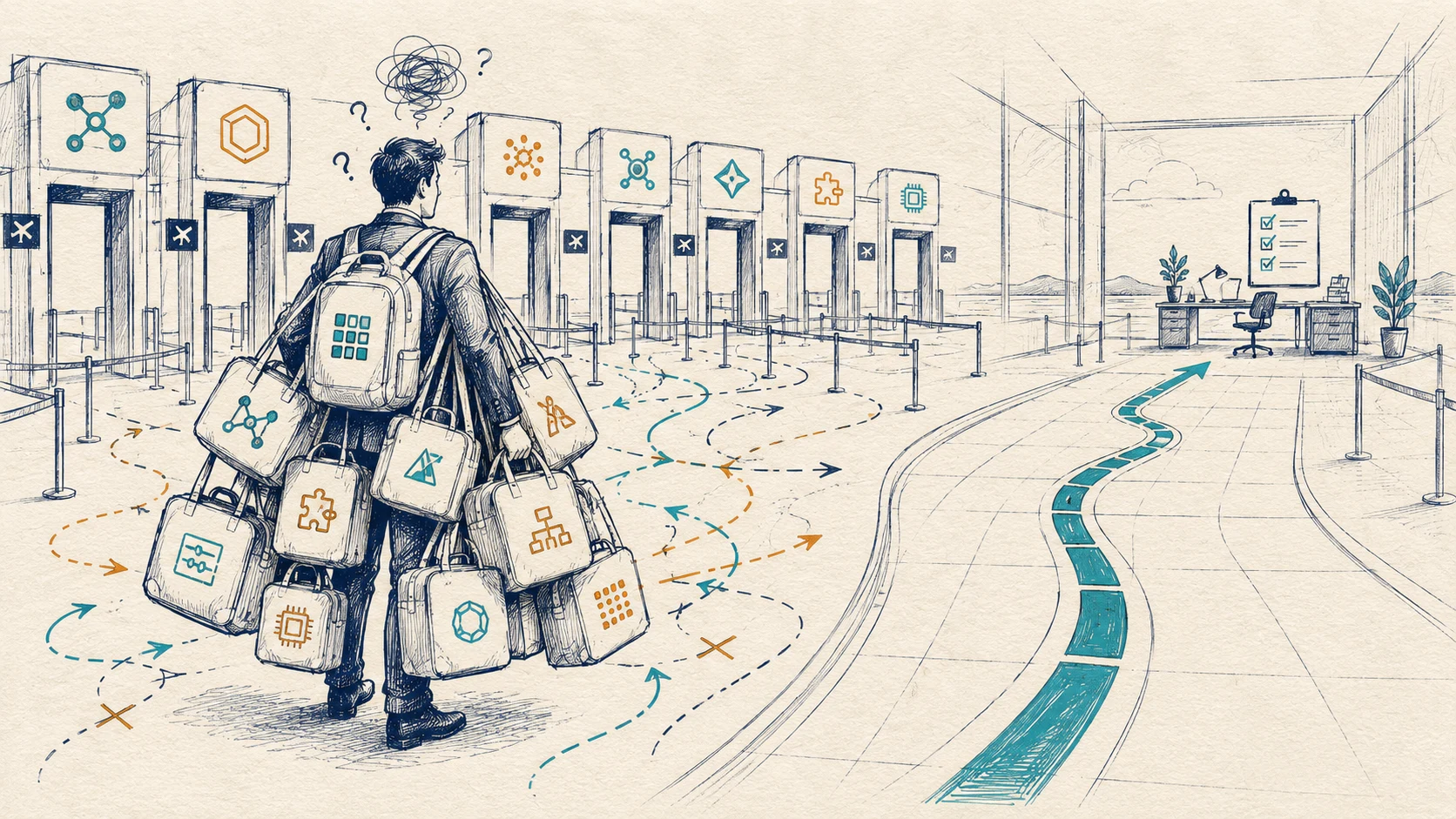
AI Tool Tourism: When to Switch AI Tools?
AI tool tourism is chasing every new tool until your workflow breaks. 3 conditions show when a switch is worth it. Otherwise, breathe and keep what works.
Framework
Do You Need an AI Agent, an AI Workflow or Automation?
Most “I need an AI agent” requests need an AI workflow or plain automation. 3 questions show which, before you build the wrong one. Ask them separately.

Strategy
How Do You Detect Faulty Engines Using AI On Small Samples?
ECG-style anomaly detection flagged faulty engines in under 5 seconds by defining what normal looks like first, using 20 faulty examples in 1.3M units.
The Weekly AI Decision Brief