Do You Need an AI Agent, an AI Workflow or Automation?
Most “I need an AI agent” requests need an AI workflow or plain automation. 3 questions show which, before you build the wrong one. Ask them separately.
Short answer: most requests for an AI agent need an AI workflow, or ordinary automation. 3 questions tell you which.
A client sees a fancy demo and comes back with, “I need an AI agent to do my job.”
But how does the current process look? What information does it need? Where does that information come from, and who checks whether the final output is right? Those questions often haven’t been thought through. The demo showed the output. It didn’t show the data work and operational responsibility around it.
In my consulting experience, many of these requests turn out to need an AI workflow rather than an AI agent. Sometimes they need ordinary automation. So let’s look at the difference through one business activity: researching companies for a go-to-market strategy.
AI agents vs AI workflows vs automation: 3 different ways to do the work
The distinction is where you need interpretation and where you need the system to choose its next step. These are not 3 compulsory stages every company must progress through.
For this comparison and bookish definition, “automation” usually means rules-based automation. But broadly, all 3 approaches are meant to automate the work. And an AI workflow does not have to use only a large language model: a classifier or another suitable model can also handle a defined step.
The wider AI umbrella matters because the model should fit the work, not the other way around.
| Approach | What is defined beforehand? | Where does AI help? |
|---|---|---|
| Rules-based automation | The rules, steps and conditions for moving between them. | It may not need AI at all. |
| AI workflow | The process, including the points where interpretation is required. | Reading, extracting, classifying, comparing or drafting within those steps. |
| Bounded AI agent | The goal, available tools, constraints and limits. | Choosing some next steps as new information surfaces. |
An AI workflow can have branches, checks and repeated steps. It need not be a straight line. An agent can work inside that workflow rather than replace it.
Take a fixed process: collect an account’s information, check whether it matches your customer profile, prepare the research and send it for review. You might let an agent investigate a competitive gap in the middle of that process. The collection and review still follow your workflow. Only the investigation gets room to change its approach.
Why give the whole process that freedom when only the investigation needs it? Keep the dependable steps as they are.
 Keep the workflow fixed; give only the investigation room to choose its approach.
 Keep the workflow fixed; give only the investigation room to choose its approach.
Scroll sideways to explore the full diagram.
Anthropic’s distinction between workflows and agents makes this point clearly: predefined code paths versus a model dynamically directing its process and tool use. Neither label tells you whether the business should grant permission to act on the result.
How Do You Choose Between an Agent, a Workflow and Automation?
Ask these separately:
- Does the information need interpreting?
- Must the system choose what to investigate or do next?
- May it execute the resulting action?
Reading a report is different from deciding what to research after reading it. Both are different from contacting a prospect, changing a price or committing the company to something.
This is the distinction I make manually while consulting. You can let a system investigate without letting it make the final commercial decision. Now imagine how that applies to GTM research.
 Interpreting information, choosing the next step and permission to act are different decisions.
 Interpreting information, choosing the next step and permission to act are different decisions.
Scroll sideways to explore the full diagram.
A GTM case study: researching the same account 3 ways
Let’s take a company you want to reach for a go-to-market strategy. You need to know whether it fits your customer profile, what it is trying to achieve and where your offering could help. Those are connected pieces of work, but they don’t all need the same approach.
We’ll use a solar company as an illustrative account. This is a teaching example, not a claim about a particular client deployment. The 3 approaches below show where the work changes; they are not levels of intelligence you must buy your way through.
1. GTM automation: identify and enrich the right account
Rules-based automation fits the repetitive collection and handoff work when the process already works and the conditions are clear.
You know the industries you want to reach. You have a definition of your ideal customer: perhaps geography, company size, product category and relevant roles. Fetch the available company information, remove duplicates, apply those rules and put matching accounts in front of the right person.
There may be several systems involved. That doesn’t make it an agent. If the conditions and actions are already defined, it is still automation.
This gets the plain enhancement work done. It helps you identify the right companies, but it hasn’t yet established what they are trying to achieve or whether your offering is relevant now. A complete contact record is not a complete reason to approach someone.
2. GTM AI workflow: understand the company’s direction
An AI workflow fits when you know what information to collect and how the process should proceed, but the information itself needs interpretation.
You want to understand what the company is doing and what its future goals look like. That could come from an investor meeting, quarterly report, leadership interview or podcast. Is it expanding? Where is it investing? What shortcomings or priorities does the leadership keep discussing?
Defined research questions and criteria tell the workflow what to look for. It reads the selected reports and extracts the company’s goals. A retrieval-augmented generation (RAG) step then finds relevant passages in the approved sources and links claims to evidence. The workflow prepares a supported brief, comparing those signals against your offering and putting the relevant ones in front of the salesperson.
These are still defined steps: interpret against the research brief, retrieve supporting evidence, prepare the output, then send it for human review. The reading needs AI. The sequence does not necessarily need an agent.
The same applies to financial and industry information. A change in inventory or debtor days can give you something to investigate. It doesn’t, by itself, explain why that change happened. The useful brief separates what the source says from what you are inferring.
This is where an AI workflow facilitates the person. They spend less time collecting and joining information, and more time understanding whether there is a relevant conversation to have.
3. GTM agent: let a discovery change the research direction
An agent becomes useful when what you discover should change the next investigation, rather than simply fill another field in the same brief.
Now take the solar account a step further. You have identified that it fits your customer profile and collected its recent goals. You compare it with its peers. Competitors have a stronger residential presence, while this company has fewer local centres and has spoken about expansion.
That is not yet a reason to tell the company to open more centres. It is a reason to investigate. Is residential expansion part of its stated direction? What is limiting local presence? Does the next useful question concern distribution, installation capacity or logistics? Which of those could your offering actually help with?
The research direction changes with the answers. If distribution emerges as the issue, the next investigation should follow distribution. It shouldn’t keep collecting the same competitor facts just because they were on the original checklist.
That is the agentic part: choosing some next questions and sources within the boundaries you have set. If you have already prescribed every follow-up, an AI workflow may be enough. Reading unstructured data alone doesn’t settle the choice.
The output still goes to a human. It should show the evidence, the possible gap, where the offering might fit and what is not yet known. The salesperson makes the intervention and takes the lead to the next step.
How Does This Change Real Outreach?
 The agent's distinction is the choice of follow-up investigation, not a more elaborate report.
 The agent's distinction is the choice of follow-up investigation, not a more elaborate report.
Scroll sideways to explore the full diagram.
In my own manufacturing outreach, I sometimes start with the idea that a company may not have in-house AI capability. Research or a discovery conversation then surfaces that it already has an AI team and implementations in place.
My approach changes. Rather than only offering to surface ROI opportunities, I can explore where fractional expertise might support what the team is already doing. I look at the public information and ask different questions.
This is my manual GTM practice. New information changes both what I investigate and what I might offer. But knowing that a company has an AI team doesn’t automatically tell me that it needs fractional help. That is what the further research and the conversation are for. The system should facilitate the decision, not find a way to make every account look like a lead.
Does a bigger decision always need an AI agent?
The GTM example can make it look as though more complexity always means more agency. Does that hold when the decision involves money or a customer who needs an answer now?
Take an airline refund. A refund can be a large amount, yet the decision may already be clear. If the applicable policy establishes eligibility, amount and required checks, why ask a model to decide again? A rules-based process can handle it. Moving money and deciding what someone is entitled to are different responsibilities.
Now the passenger writes a message explaining a problem. An AI workflow can interpret the request, retrieve the booking and policy, and prepare the next step. It doesn’t need to become an agent just because the message wasn’t written in the format your system expected.
The harder scenario is a disruption where the passenger’s constraints and the available alternatives keep changing. Which connection is workable? Does a newly available flight change the options? What further information would help? A bounded agent may explore and refine those options. Permission to book, upgrade or spend remains separate.
And if none of the permitted options meets the customer’s need? That is where an authorized person may need to make an exception or handle the conversation. We shouldn’t pretend that more research gives the system authority it was never granted.
There are real improvements worth learning from. In its September 2026 announcement about Air India, Salesforce reported internal refund processing falling from roughly fourteen days to 4 hours, excluding unchanged bank processing time. That is a reported process outcome, not proof that an agent is necessary for every refund.
GTM shows where changing research direction can be useful. Yet the airline example shows why even a bigger action may not need it, and where a real edge case needs a human decision. Look at the uncertainty and the authority required, not just the amount of money involved.
 A larger action does not automatically need more agency.
 A larger action does not automatically need more agency.
Scroll sideways to explore the full diagram.
What do recent AI advances change about this choice?
The useful change is that we have more ways to put interpretation and investigation inside a working process. That gives us more choices about what to delegate. It doesn’t remove the need to choose.
One example is the recent typed decision models. TypeSafe’s Jev, for instance, can return a choice, a score against a rubric or a yes/no probability. In our GTM example, that could help assess a statement in a report against a defined question. The workflow still owns what happens with the answer.
There is movement here, not just another name for chat. TypeSafe’s October 14 Jev update announces experimental images, bounding-box output and longer context, while explicitly warning those additions are not yet ready for production use. So look at the particular decision a model can support, not just the launch headline. A correctly shaped answer is not necessarily a correct answer.
There is also progress in the infrastructure around longer agent work. In its April 2026 Managed Agents engineering article, Anthropic describes separating the model’s working loop from the tools that execute actions and from the stored record of the work. It keeps service credentials outside the environment running AI-generated code.
Why does that matter to a business? An investigation may need to recover after an interruption or retrieve evidence that no longer fits in the model’s current context. You also want the system to use an approved tool without exposing the underlying credentials to the code it generates. Those are practical concerns beyond how good the first answer looks.
For our GTM example, that could support an investigation that changes direction while keeping the evidence and access boundaries in place. It still doesn’t mean the researcher may contact the prospect. Nor does a stored history prove that every conclusion is correct.
So the current question is more useful than “Can AI do this now?” Ask which part of your process the newer capability improves. If a defined AI workflow already does that part well, what would extra autonomy add?
What Does an AI Agent Cost Beyond the Demo?
Data is a cost. Defining the rules and constraints is an operational responsibility. Neither disappears because the model can produce an impressive answer.
What information needs to be fetched before the work begins? What becomes available during it? Where do you store it? Who is allowed to access it, and how will governance work across those sources?
Then there is the responsibility for whether the output is right. Who checks it? Who maintains the system when sources, rules or the business change? These questions apply to AI workflows too; extra freedom to choose steps gives you more to manage, not an exemption from management.
Research also needs a limit. For the GTM brief, I want the company’s current activity, leadership’s stated direction, financial trajectory and the outlook of its field. If a source is missing, endlessly looking for parallel examples is not automatically useful work.
Set the boundaries for time, steps and cost. If the research in one area is insufficient, say so. If the person wants more, they can ask for more. Why fill the gap with something that only sounds complete?
These are practical questions to ask before buying an AI tool, not details to leave until after a purchase.
AI ROI: how much work is left for the decision-maker?
Measure the work genuinely removed from the whole process, including preparation and verification by the final decision-maker. A faster first draft is not the same as a more useful final output.
The key person may be the manager taking inputs from several employees and making the final call. If the right job removes even thirty minutes of collecting, checking and restructuring those inputs, that can matter. They have more visibility into the information and less work before the decision.
Treat that as an example, not a promised saving. Time released becomes financial benefit only when there is a credible way to use it or avoid expenditure. Don’t call it payroll saved while everyone is still doing the same paid hours.
For GTM, compare the current process with the proposed one: research effort, paid data and model costs, review and corrections, maintenance, and whether the salesperson gets a better-supported conversation to pursue. Don’t give an agent credit merely for producing a longer brief.
For the solar account, ask what the extra investigation changes for the salesperson. Do they reach the conversation with a supported question about local distribution, or with another generic company summary? How much of the research do they have to repeat before they trust it? Those are useful things to compare.
If a fixed AI workflow gives them what they need, keep it. If an agent uncovers a relevant issue the fixed brief keeps missing, compare that added value with the added research and review cost. Neither approach gets an automatic ROI advantage because of its name. The business has to make use of the output.
That is why I start with the decision the business needs to make. The extra research is worthwhile only if it helps that work enough to justify what it consumes.
What 6 Checks Should Come Before You Invest?
Use these as a sanity check with your team, not a numerical score that pretends to choose an architecture for you.
 Choose an approach, then check whether the business is ready to use it. This is not a score.
 Choose an approach, then check whether the business is ready to use it. This is not a score.
Scroll sideways to explore the full diagram.
The left column helps you choose an approach. The right column checks readiness and value. A process may suit an agent while the company still lacks the data or ownership to run it.
What to do this week
- Pick one process you want an agent for.
- Write down who does it today and who uses the output.
- Run the 3 questions: does it need interpreting, must it choose the next step, may it act?
- Put the employee and the manager in one conversation and run the 6 checks.
How the 3 fit together
You can use all 3 approaches in one system. Automate the collection that is already clear, use AI where information needs interpreting, and give an agent room to investigate where that actually helps. Keep the final authority explicit.
If the trouble is picking tools at all, read AI Tool Tourism. If GenAI is being asked to do every job, read why GenAI is a plier, not every job’s tool. And if the pattern is paying for the wrong kind of AI, see the AI Confusion Tax.
Before asking for an AI agent, put your current process beside these checks. Where do you need interpretation? Where must the next step change? And what work will genuinely disappear for the person who has to make the decision?
Frequently asked questions
What is the difference between an AI agent, an AI workflow and automation?
Automation follows fixed rules and may need no AI. An AI workflow follows a set process but uses AI at steps that need interpreting. An agent is given a goal, tools and limits, and chooses its own next step. Anthropic draws the same line between workflows and agents.
When do I need an AI agent instead of an AI workflow?
When what the system finds should change what it investigates next. If you have already written every follow-up step, an AI workflow is probably enough.
What 3 questions should I ask before building an agent?
Does the information need interpreting? Must the system choose what to do next? May it act on the result? Ask them separately; they are different decisions.
Does a bigger decision, like a refund, need an AI agent?
Not necessarily. If policy already sets eligibility, amount and checks, rules can handle it. Look at the uncertainty and the authority needed, not the size of the money.
What does an agent cost beyond the demo?
The data work behind it, the rules and limits, and a person who checks the output and maintains the system.
How should I measure the ROI?
Count the work genuinely removed from the whole process, including preparation and checking by the final decision-maker. Time saved counts as money only when you have a credible way to use it.
Is this where your AI is leaking?
A 30-minute Clarity Call shows where the logic between your data and your decisions breaks. No pitch, no deck.
Framework
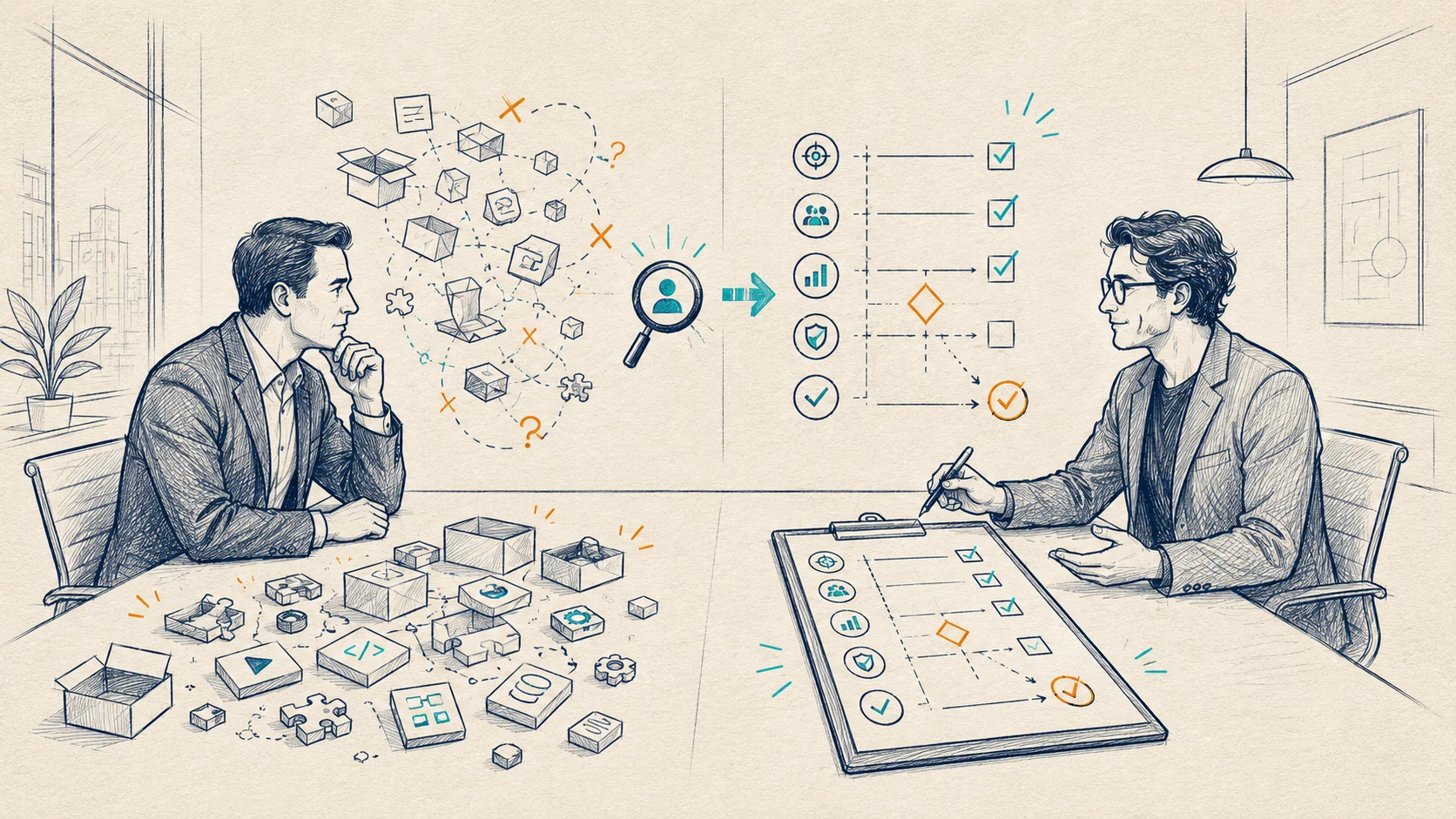
Before You Buy an AI Tool, Ask These 6 Questions
6 questions separate a real AI capability from a better demo: data, output, governance, ROI, upgrade path and ownership. Ask them before you buy.

Framework
Is GenAI Just a Pair of Pliers in Your AI Strategy?
GenAI is excellent for language and weak for math, optimization or network problems. Name the problem class first, then pick the right tool from the toolbox.
Framework
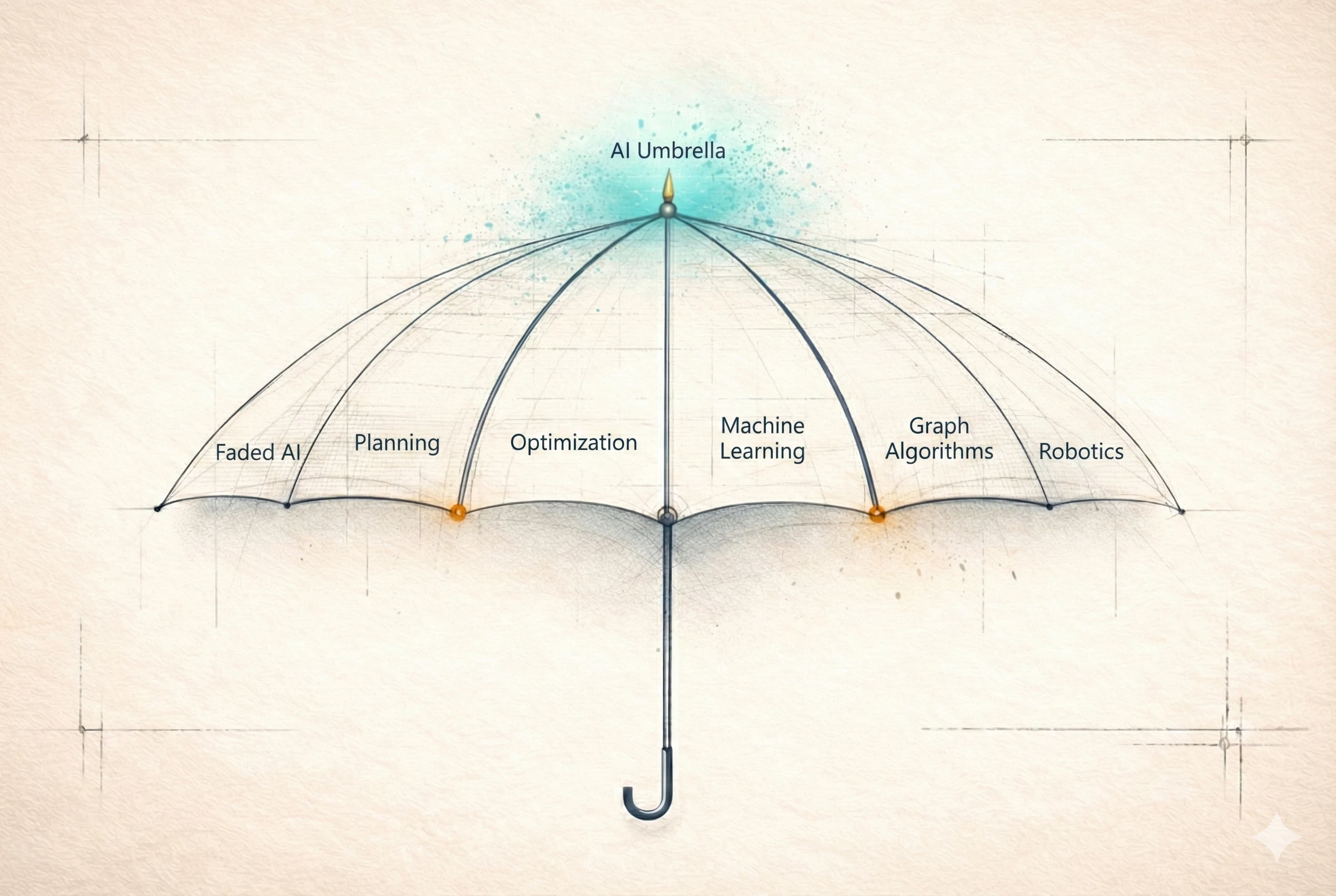
The AI Umbrella: Which Part of AI Does Your Problem Need?
AI is a toolbox, not one gadget. The AI Umbrella maps 5 pillars, from machine learning to optimization. GenAI is about 8.6% of the AI market.
The Weekly AI Decision Brief