AI in Procurement: Vendor Rationalization with AI Agents
AI in procurement, in practice: how AI agents rationalized a manufacturer's vendors, from requisition to award, while procurement kept the final call.
A vendor listed a raw material in the first catalogue pull. On the next pull, it was gone.
The analyst said, “you’re not telling us the right story.”
We went back to the vendor. They no longer held the licence needed to supply it, so it had vanished from their site and catalogue. The analyst said: if this happened here, other vendors may have the same problem.
They were right. Many vendors had expired licences, and nobody knew, because licences and norms were nowhere visible before. That one catalogue change did more to cut the vendor list than any rule we wrote.
This is how we set up AI agents for vendor rationalization in a manufacturer, what each agent does, and where the human stays in charge.
What is vendor rationalization, really?
The client was a global materials-science manufacturer: about 7,000 vendors and more than 100,000 products and raw materials.
Requirements always come in on top. For each one, analysts spent a lot of time finding when it was sourced earlier, from whom, and at what price. And for many raw materials they could use a bigger or better-quality vendor, but didn’t, because the price was lower elsewhere.
So the core theme was not rationalizing on price. It was rationalizing on quality and coverage, so the company isn’t dependent on small or low-quality vendors. Price alone doesn’t give the full picture.
And the number was never the target. As I said to the team: “The goal was not to reach five thousand. The goal is to rationalise the vendors in the best possible way, in the interest of the company.” The count follows from good decisions, one requirement at a time.
How do the AI agents fit together? The kitchen analogy
Each agent is one step of the recipe. The procurement manager is still the one cooking.
The analogy I use on calls is a kitchen. Here it maps one to one.
| In the kitchen | In vendor rationalization |
|---|---|
| Decide what to cook | Decide on quality, coverage and price, not price alone |
| Check the stock at home | Existing contracts and purchase-order history |
| The recipe | The agent flow, step by step |
| The right ingredients in the right quantity | The optimiser: quality tolerances and quantities |
| An ingredient past its date | A vendor whose licence has expired |
| The small decisions while cooking | The procurement manager’s calls |
AI gives you the whole recipe. But you are still the one in the kitchen, making the dish one step at a time.
How do you set up AI agents for vendor rationalization, step by step?
Below is the flow from a simplified demo I built to show the pattern. It is not the client system, which stays under NDA, and it is not a product. The screens use sample data for bathroom fittings, so the numbers in them are small on purpose.
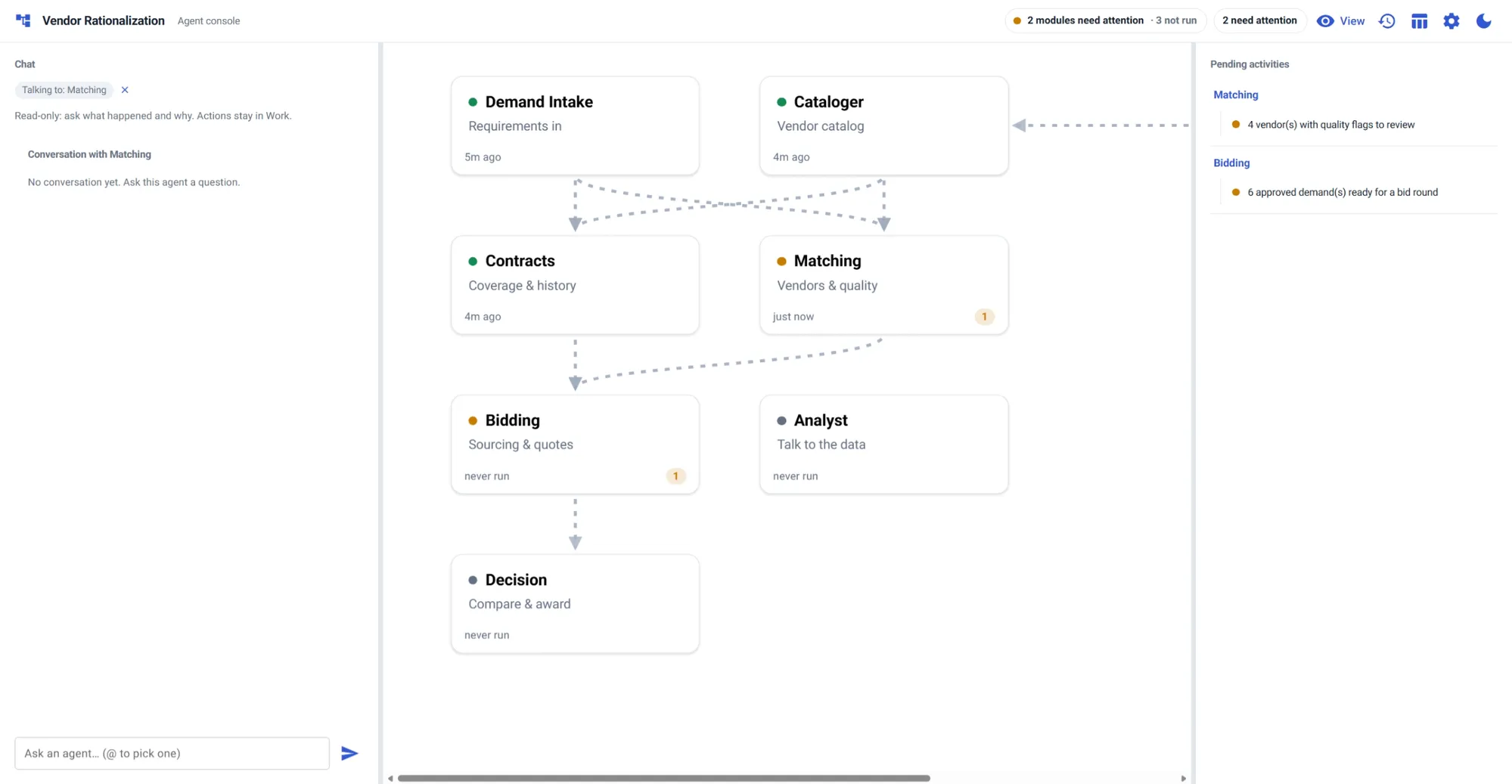 The agent console. Each card is one agent. The panel on the right is what is waiting on a person.
Step 1: Turn the requirement into demand lines
Requisitions arrive as free text or a spreadsheet. The first agent reads them into structured demand lines: category, quantity, unit, specification, attributes, and the matching item code. It puts each raw material in the right group, so everything after it compares like with like.
Then a person approves the demand. Approved lines become read-only.
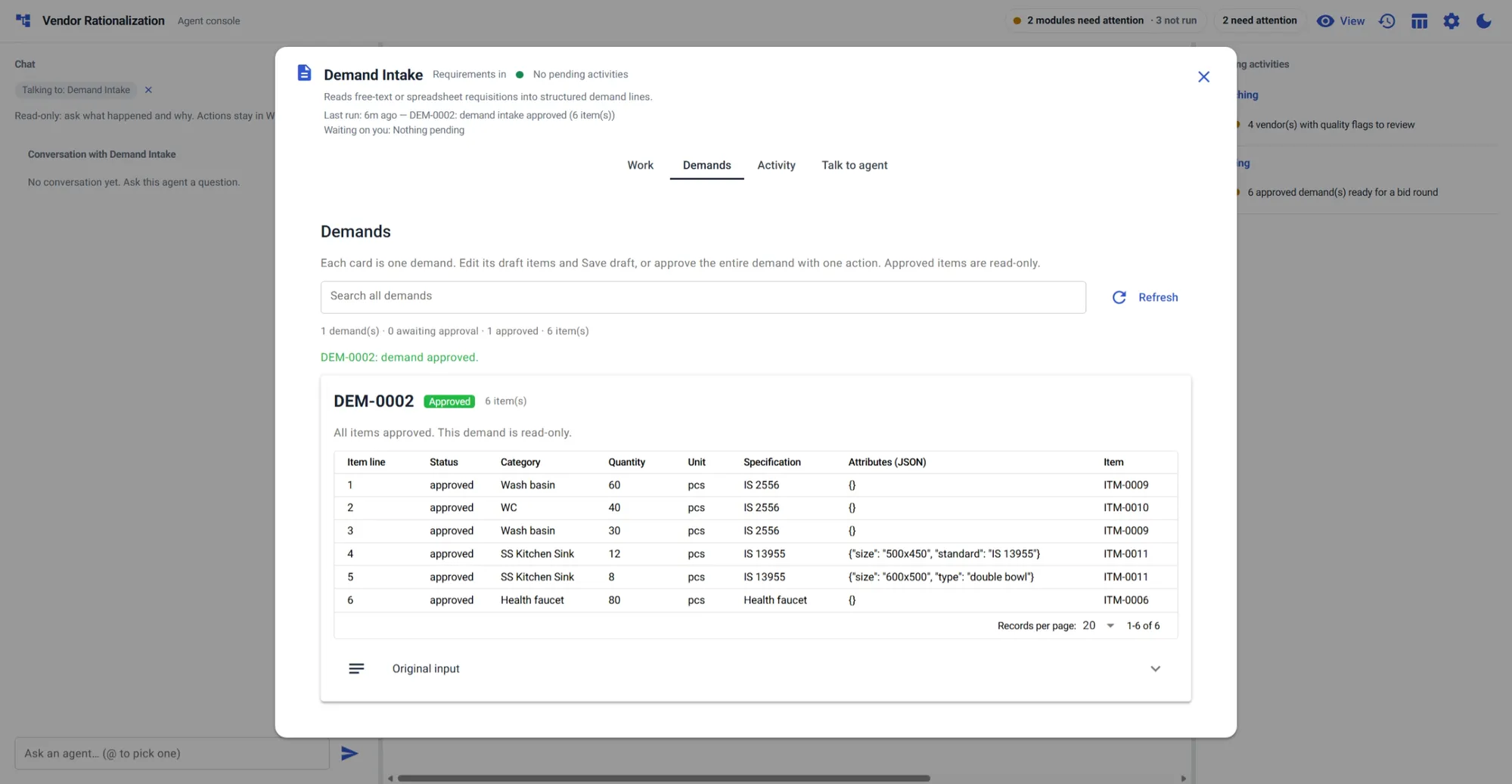 A requisition read into six demand lines, each tied to a specification and an item code, then approved by a person.
Step 2: Keep the vendor catalogue current
The second agent keeps vendor offerings updated from vendor websites and catalogue PDFs, and parses which raw materials and services each vendor supplies. This is prefetched, so it is ready before the requirement arrives.
After the licence story, the cataloguing agent also records licences and credentials while it scrapes. For critical materials, procurement flags “needs licence checked”, and it is verified when the quote is requested. That was not designed in. It came from an analyst noticing a catalogue change.
Step 3: Check what the contracts allow
In parallel, the contracts agent looks at earlier contracts and purchase orders: what was bought, at what cost, in what quantity.
This matters more than people expect. If a contract runs for a duration, you can’t forcefully reduce or break it. The contracts agent answers a simple question: can we procure externally or not, or will the current contract suffice? That is also why the vendor count falls slowly. Consolidation happens as contracts expire.
Step 4: Match vendors on quality, not only price
The matching agent takes the demand lines and the catalogue and finds which vendors can supply each raw material, and whether the same quality vendor supplies other materials, in other forms, that could improve the product.
When something doesn’t fit, it doesn’t decide. It raises a flag. In the demo you can see it: “4 vendor(s) with quality flags to review”.
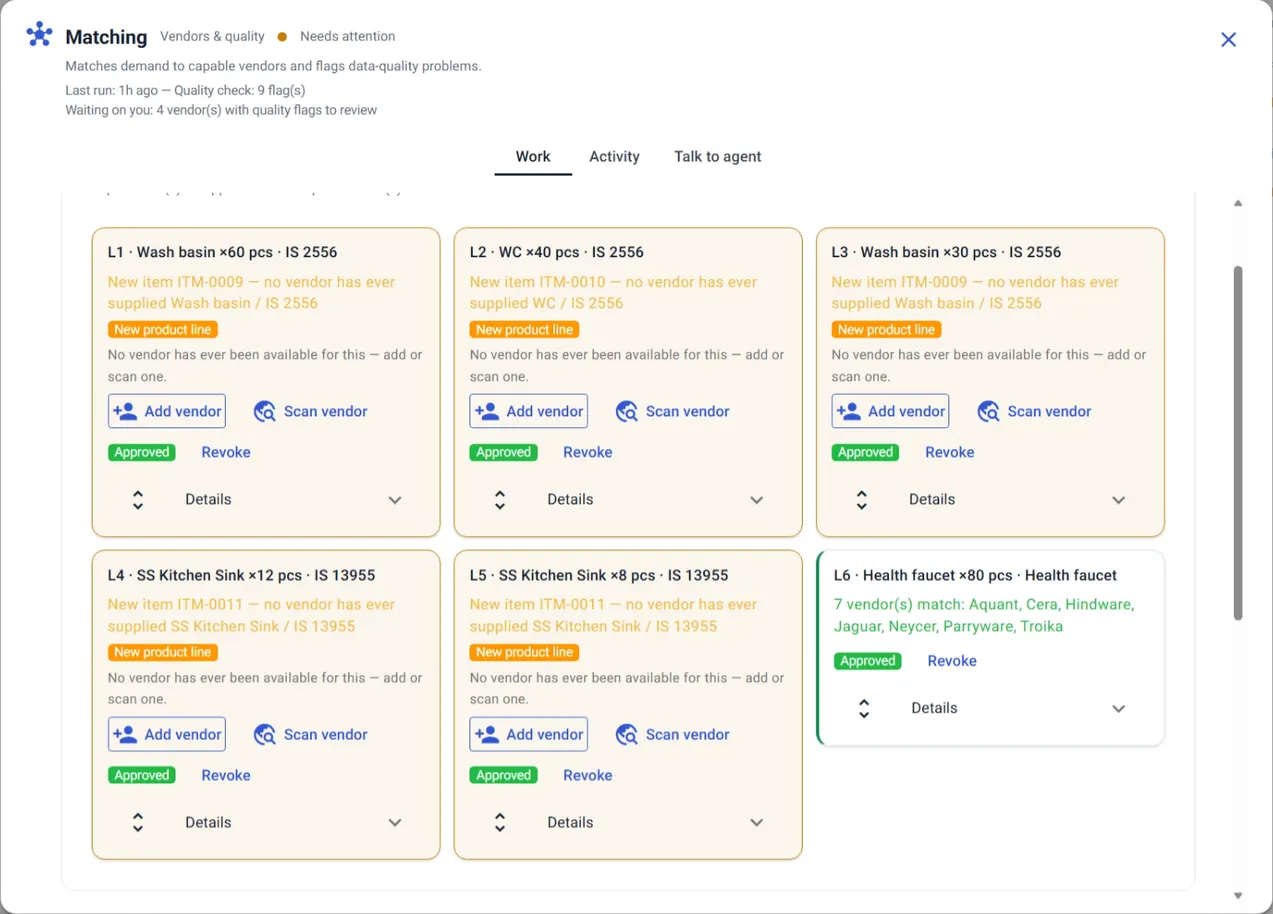 Matching does not guess. Where no vendor has ever supplied an item, it flags it, and a person chooses to add or scan a vendor.
When does vendor optimisation run?
Continuously, at the contracts and matching level, with every new requirement.
This is the part people get wrong. Optimisation is not a one-day exercise. The purchase team keeps getting new requirements, and deliveries from earlier contracts are already running. You cannot stop one day, optimise everything, and cut off all the earlier contracts.
So the optimisation runs continuously, at the contracts and matching level. With every new requirement it answers one question: do we continue with the current vendor, or do we have other vendors worth asking for bids? Only the second answer goes forward to bidding.
Step 5: Invite bids and make the quotes comparable
The bidding step combines old contracts and the candidate vendors and says whom to ask for revised price bids.
When the quotes come back, they are never apples to apples. One includes extras, another excludes taxes. The agent normalises the quotes so they can be compared fairly.
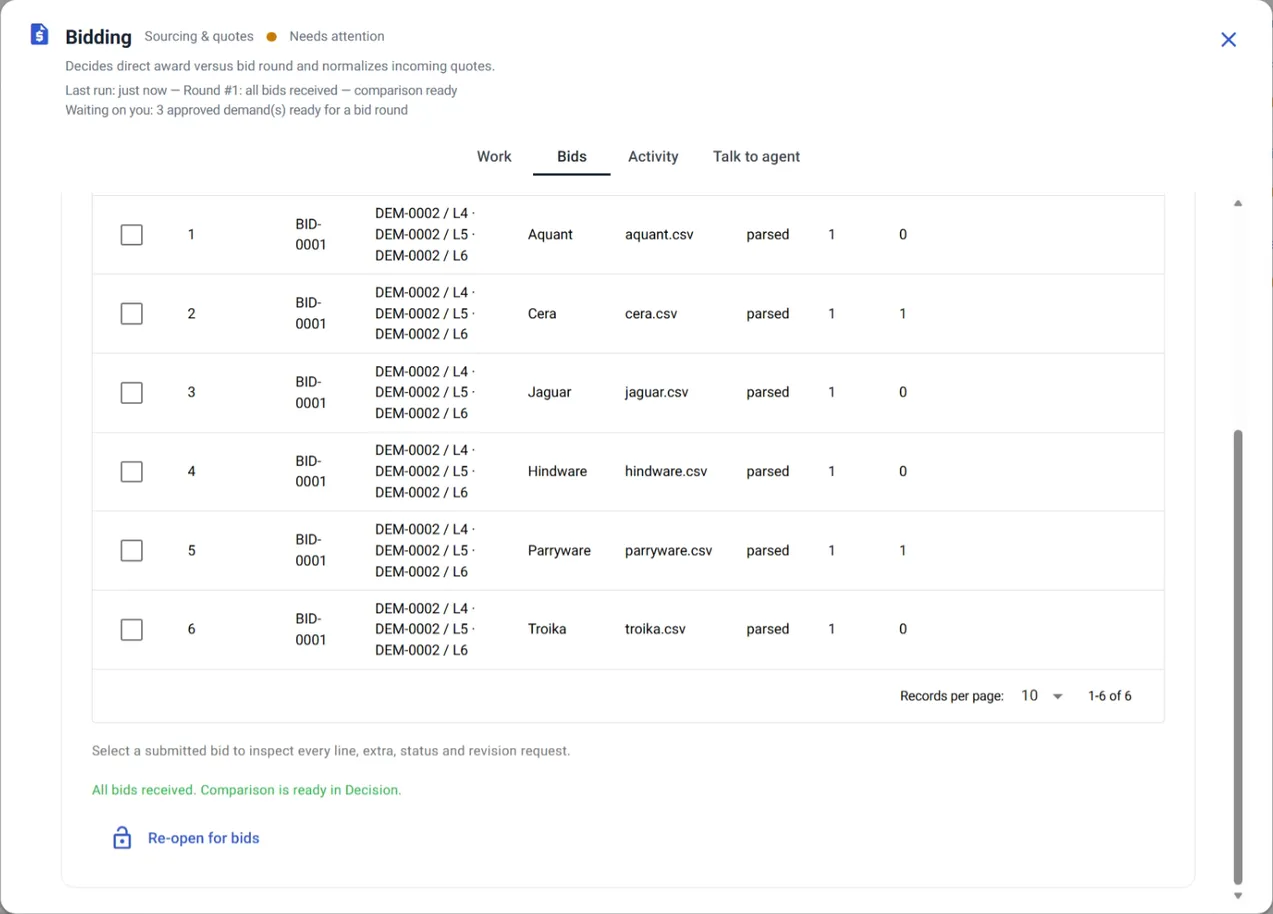 Every quote is parsed against the same demand lines before anyone compares them. The round can be re-opened if a bid needs revising.
Step 6: Compare and award, by a person
The procurement officer and the analyst take the final call. The decision step puts everything in one place: the demand, the candidate vendors, their quality flags, the contract position and the normalised quotes. A person compares and awards.
Step 7: Ask the data why
The last piece is the analyst agent: talk to the data. The chat is read-only. You can ask what happened and why, but actions stay in the work screens. Nobody approves a vendor from a chat box.
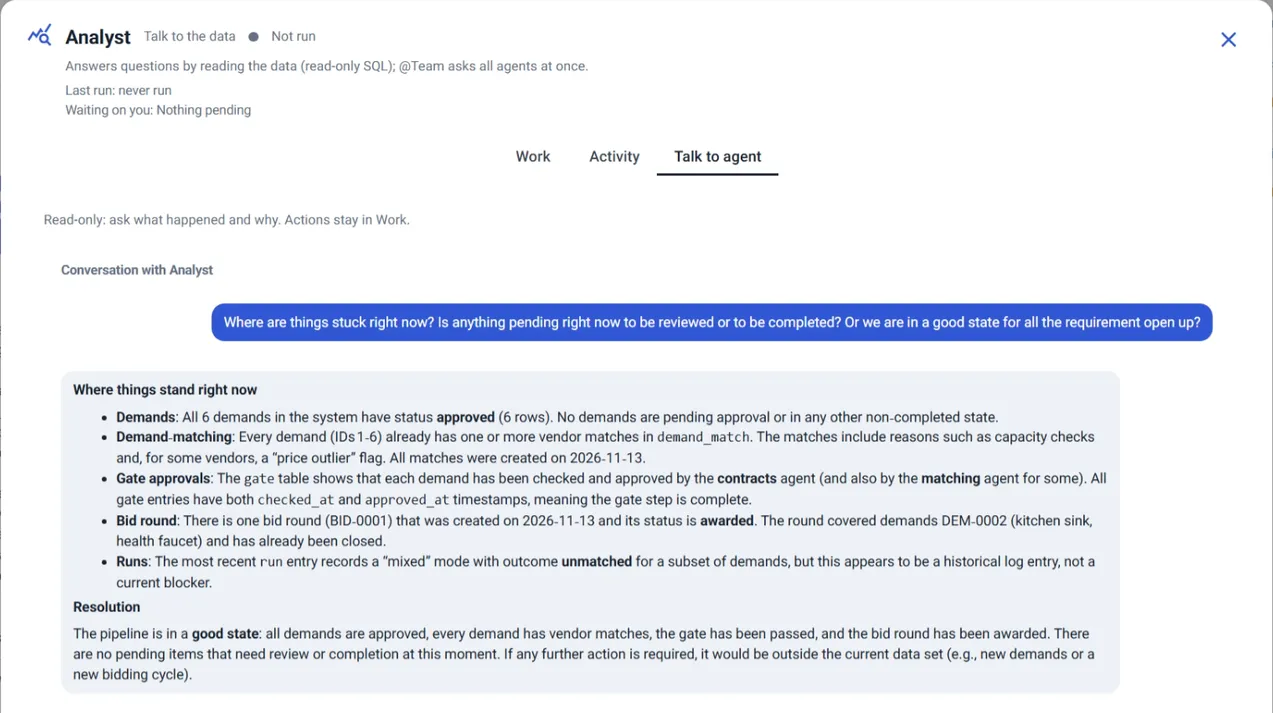 Ask “where are things stuck?” and the Analyst reads the data, read-only, and tells you what is pending. Here, nothing is.
Why is vendor optimisation a tool, not another agent?
With a plain agent, the technicalities got lost and quality tolerances were dropped.
A material isn’t just quantity and name. It comes in varieties with quality tolerances. That is why I built the optimisation as its own MCP server: a separate tool the contracts and matching agents call. It takes the raw material, its quality limits and the catalogue input for the selected vendors, and optimises across all the products being procured together, not one requirement at a time.
Two things came out of it that nobody asked for.
- Today’s procurement doesn’t cover the long-term need, and other procurements in the pipeline aren’t visible yet. So the optimiser also looks at past consumption history and says, “you’ll likely need more, given last time”.
- Better quality is sometimes nearly free. It flags when a superior-quality material can be bought at a similar or slightly higher price.
The maths is a separate tool, not LLM judgement. The agent facilitates with the relevant information around the raw material, the vendor and the contracts, and the procurement manager does the finalisation. If you want the longer version of where an agent fits and where a plain workflow is enough, I wrote about AI agents vs workflows vs automation.
What did vendor rationalization with AI agents deliver?
These are early pilot results, and the programme is still running.
| Measure | Result |
|---|---|
| Vendors | About 7,000, falling toward 5,000 as contracts expire |
| Saving | About $100K a month |
| Analyst time | 15 analyst hours a week freed |
| First value | About 3 weeks, when the proof of concept found the common vendors supplying the same product |
Many of the vendors dropped were very small procurement firms that weren’t providing quality, or vendors with expired licences. Each one was a person’s decision. The full write-up is in the vendor rationalization case study.
What I’m working on next is one more layer: small, fast “System 1” style decision models for the routine calls, so the flow gets faster and cheaper without sending every small decision to a large model.
What should procurement check before starting?
Five things: the goal, the contract and PO history, clean item codes, who approves at which step, and which part is maths.
If you are thinking of doing this in your own procurement team, check these first.
- Is the goal quality and coverage, or only a smaller number? If it is only the number, you will cut good vendors with bad prices and keep bad vendors with good ones.
- Can you get the contract and PO history? Without it, the agents can’t tell you what you’re allowed to change.
- Are your item codes and specifications clean enough to match? If the same material sits under different names, matching is the first job, not the model.
- Who approves, at which step? Write it down before building. In our case, the demand, the flags and the award all wait on a person.
- Which part is maths? Tolerances, quantities and multi-product optimisation belong in a tool, not in a prompt.
The same questions apply before you buy any procurement AI tool; I’ve put six of them here.
Where does the procurement manager stay in charge?
At every decision that matters: the demand, the quality flags and the award.
It’s not that humans have to make the checks only. It is to facilitate the human so that they can do their job well in less time. Agents are here to facilitate, not to overload with work. The early pilot results are in the vendor rationalisation case study.
So, what is that one repetitive task you think you’re doing well, but that needs a lot of assumptions and validation to make it complete? And if those assumptions break, like the vendor catalogue did for us, what will be the consequence of a bad decision?
Frequently asked questions
What is vendor rationalization?
Reducing and reshaping the vendor base so the company buys from the vendors that serve it best on quality, coverage and price, not only the cheapest one per order. The number of vendors cut follows from those decisions; it is not the goal by itself.
Can AI agents choose vendors on their own?
They should not. In our setup the agents gather and prepare the information around the raw material, the vendor and the contracts, and the procurement manager makes the final award. Agents are there to facilitate, not to overload people with work.
Which steps of procurement can AI agents handle?
Reading free-text or spreadsheet requisitions into structured demand lines, keeping vendor catalogues current from websites and PDFs, checking past contracts and purchase orders, matching vendors on quality, inviting bids and normalising quotes so they compare like for like.
Why use a separate optimisation tool instead of another agent?
A material is not just a name and a quantity; it comes in varieties with quality tolerances. A plain agent dropped those tolerances. Optimising the best vendor across all products bought together is maths, so it runs as its own tool that the agents call, not as LLM judgement.
What results did vendor rationalization with AI agents deliver?
For a global materials-science manufacturer, early pilot results were roughly 7,000 vendors moving toward 5,000 as contracts expire, about $100K a month saved and 15 analyst hours a week freed. These are preliminary pilot figures and the programme is still running.
Is this where your AI is leaking?
A 45-minute diagnostic shows where the logic between your data and your decisions breaks. No pitch, no deck.
Business
Who Should Explore AI Tools Inside a Business?
A practical operating rule for assigning AI tool exploration by temperament, not title, so curiosity creates operating memory instead of distraction.
Business
AI Tool Tourism
Why chasing every new AI tool creates cognitive load, workflow breakage, and fragmented productivity — and the three reasons that actually justify a switch.

Strategy
AI Audit: The 3 Questions I Ask Before Any AI Build
Most AI shortlists start with the tool. Run every idea through A.R.T., Applicability, Readiness and Transformation, before anyone writes code.
The Weekly AI Decision Brief